

For a few days at the end of October into November 2026, the internet turned "Sam Altman" into a punchline. Speaking with Stripe CEO John Collison on the Cheeky Pint podcast, the OpenAI CEO was pushing back on a specific idea: that open-source models running locally on personal computers mean the industry won't need as much data center buildout after all. His response:
"From a global allocation perspective, actually, it's quite terrible to have everybody have a bunch of the world's limited supply of DRAM sitting in their own computer, and being used maybe 5% of the time. Like, you want maximum utilization in the cloud if you're trying to deal with this very supply constrained environment. And somehow many people's intuition is the opposite of that."
What Sam was actually targeting was DRAM. This is system memory, not GPUs. The two got blurred together fast in the backlash, but they're different resources with different supply chains.
The reaction was swift and merciless. PC gaming communities posted screenshots of their rigs in protest. Elon Musk weighed in on X: "The people deserve to have their RAM too!" which got 73,000 likes in a day.
Within days, Altman was being called "Ram Altman" across social media, a nickname he leaned into. He even briefly changed his own X display name to match, while insisting the comment had been taken out of context. "I have been arguing for the world to ramp up memory production for a long time," he posted. "I want you to have so much RAM. Let's build more."
It's a good meme cycle. It's also sitting on top of a real question worth taking seriously once the jokes settle: What should actually happen to hardware that spends most of its life idle?
Part of why this blew up isn't really about the quote itself but rather timing. DRAM and GPU prices have been climbing all year because of AI-driven demand, and consumers have been feeling it directly: used PS5 Pro units reportedly jumped to $1,399 after an official price increase tied to the memory shortage, Nvidia's RTX 5080 reportedly vanished from the market weeks after the RTX 5090 was effectively discontinued, and at least one report puts the price floor for a basic 32GB kit of DDR5 at roughly $450. People already frustrated about memory prices heard the CEO of one of the companies driving that demand suggest their existing hardware was being used inefficiently. The reaction would have been sharp regardless of nuance.
Setting aside the framing that triggered the backlash, there's a substantive argument sitting underneath it. If you listen to the full podcast interview, you’ll see that Altman spent a chunk of the same conversation arguing that the "invisible hand" is failing to bring new DRAM and GPU supply online, despite record prices that would normally be expected to pull in investment. His explanation is that memory makers have been burned by boom-bust cycles for decades. He says it: "for a very long time, if you were a producer of DRAM, you would invest $20 billion of CapEx to make $19 billion.” He argued that history makes them conservative even now, when the economics have flipped dramatically in their favor. He points to turbines, batteries, concrete, and steel as examples of industries where high prices are pulling in new capacity, and argues memory and chips aren't responding the same way yet.
That's a legitimate sophisticated supply-side argument, and it's consistent with his later clarification that he wants more memory manufactured, not less hardware for consumers. Separately in the same interview, he talks about wanting a "compute glut" where "anyone who wants a computer, for whatever reason, can have one," and about OpenAI building its own chip specifically to help address the shortage.
So the instinct underneath his comment, that idle hardware sitting unused while the exact same resource is in short supply elsewhere is a real inefficiency, isn't the part that deserved the pile-on. The reflex in his first answer, however, when asked about idle hardware, was to go straight to centralizing it into the cloud. That’s in contrast to a model where the hardware stays put and gets used more efficiently where it already sits. Which is, of course, where those of us in the decentralized compute space have been operating for years.
Taking Altman's stated intentions fully at face value, he says he wants more memory manufactured, not less hardware in people's hands. OpenAI, in fact, raised its projected infrastructure spending to roughly $750 billion through 2030, across deals that include 6 gigawatts of data-center capacity with Oracle, a $138 billion, eight-year arrangement with Amazon Web Services, and a $250 billion incremental commitment through Microsoft Azure.
More directly relevant to the DRAM conversation specifically is Stargate, the AI data-center initiative backed by OpenAI together with Oracle and SoftBank announced in late 2025, where preliminary agreements were signed for up to 900,000 DRAM wafers per month. Independent capacity data from TechInsights puts that at roughly 40% of projected global DRAM output for 2025.
A call for abundance doesn't erase the structural reality. The proposed fix to pool the world's idle DRAM into the cloud for maximum utilization still means pooling it into infrastructure that Stargate and its partners are simultaneously consuming nearly half the available global supply to build.
"Centralize idle hardware" is not neutral guidance but rather explicitly about centralizing into someone's infrastructure, funding someone's business model.
This is why a distributed model is structurally different, not just cheaper or more convenient: a marketplace that matches idle GPUs to demand while leaving ownership with the original owner doesn't have this conflict of interest. Nobody's business model depends on convincing hardware owners to give up their hardware, because nobody's asking them to give it up in the first place.
There are two different answers to "what do we do about idle hardware," and they lead to very different places:
Centralize it. Move the resource out of personal devices and into hyperscale data centers, where utilization can be managed at scale by whoever owns the infrastructure. This is the instinct in Altman's original framing, i.e. efficiency through consolidation.
Leave it where it is, and bring the demand to it instead. Build a coordination layer that matches idle capacity with the people who need it, wherever that capacity already sits. Ownership stays distributed. Efficiency comes from matching, not consolidation.
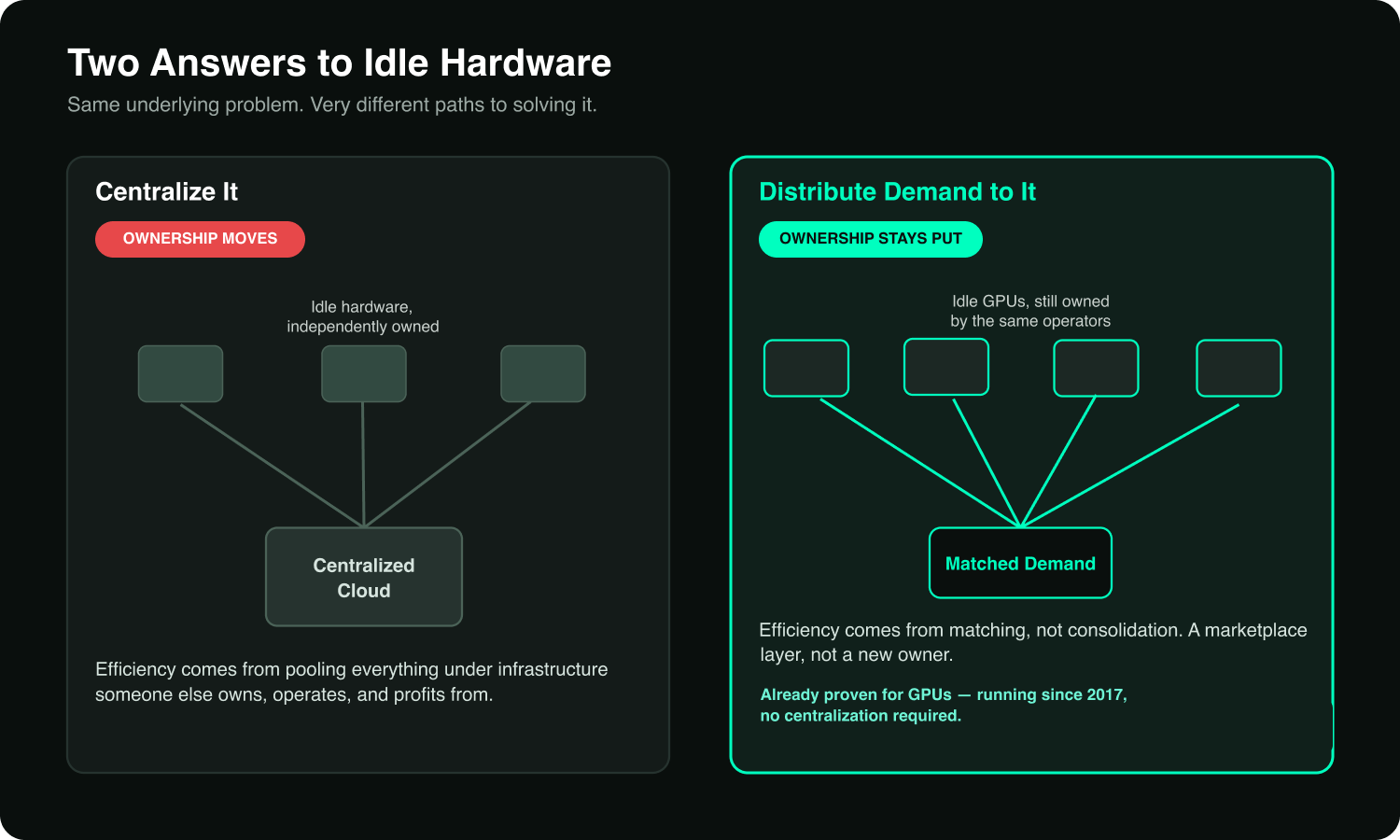
The second model isn't a hypothetical counter-argument. For GPUs specifically, it's already running in production, at scale, for years.
Render Network has been coordinating distributed, independently-owned GPU capacity since 2017, long before "idle compute" was a mainstream talking point. Dispersed extends that same model to AI and general-purpose compute: GPU owners keep their hardware, register it with the network, and earn rewards when the network matches their idle capacity to builders who need it. Nobody centralizes the hardware. Nobody gives up ownership or ships their GPU anywhere. The inefficiency Altman described for DRAM, that is, valuable hardware sitting idle while demand for it exists elsewhere, gets addressed by routing demand to the hardware, not by routing the hardware into someone else's data center.
To be clear, Dispersed doesn't touch DRAM. What decentralized GPU networks like Dispersed demonstrate is that the underlying inefficiency Altman pointed at doesn't require the centralizing answer to get solved. A distributed, ownership-preserving marketplace is a working third option between "hardware sits idle" and "give up your hardware to a hyperscaler," already proven out on exactly the kind of consumer-owned hardware this entire debate was about.
Idle hardware is a real inefficiency, in DRAM and in GPUs alike. Altman's underlying point holds up better than the backlash gave it credit for. The interesting question is: what does the right fix look like? One path centralizes the resource and asks owners to give it up. The other builds a market that activates it without moving it an inch. For GPUs, that path has already been laid out.
Whether DRAM eventually gets an answer shaped the same way will be interesting to watch for (and definitely more interesting than the meme cycle had room for!).


