
Most comparisons of serverless GPUs vs. dedicated GPU instances were written for a world of predictable, steady-state inference: one model, one endpoint and (more or less) known traffic.
Autonomous agents don't behave that way. A single agent invocation might spin up an embedding step, a planning step, a tool call, and a generation step. Each of these would have a different hardware profile and each would trigger an unpredictable moment. Sometimes these would fan out into several sub-agents at once.
That mismatch is why the "serverless vs. dedicated" question may keep resurfacing as builders put together agent infrastructure, and why most answers to it are incomplete. A framework can help evaluate the tradeoff across four dimensions pertinent to agents: cold starts, idle cost, memory persistence, and multi-agent coordination.
Dedicated (reserved) GPU instances allow you to provision a specific GPU (or cluster) and it's yours whether or not a request is in flight. This means it’s running and billed, though available. It gives you predictable latency but also wasted spend during idle windows.
Serverless GPU execution is what you get when compute is provisioned per-invocation and taken down after. You pay for what runs, but every cold invocation pays a latency tax while a container pulls, hardware allocates, and a model loads into memory.
Most real deployments aren't purely one or the other. They're a mix, and the right mix depends on how bursty and state-dependent your agent workloads are.
"Cold start" gets used as a single number, but it's really the sum of four separate delays:
Dedicated instances skip all four because the model is already resident and warm. Serverless architectures pay some combination of these on every cold invocation. The discipline of reducing cold starts is really about reducing or hiding these four costs, not eliminating the tradeoff.
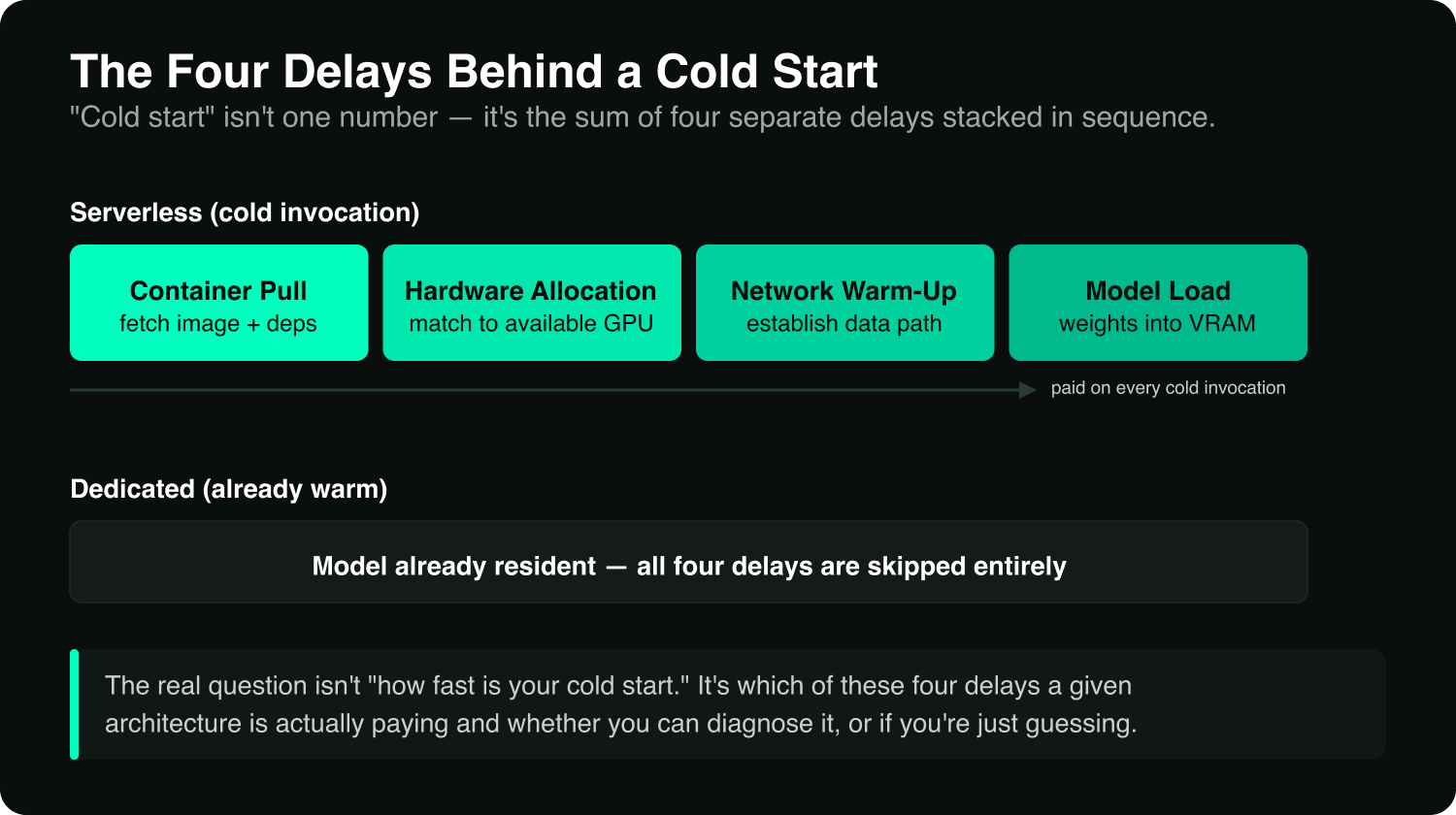
A Docker-container execution model packages a job once and runs it against whatever node in a distributed pool matches the hardware spec. It mostly affects delay #2: instead of being bottlenecked by a single provider's regional capacity and scheduler queue, the job is matched against a larger pool of available GPUs that is geographically distributed. That doesn't make cold starts disappear, but it changes what's actually causing the wait. This has an impact when you're trying to diagnose latency in production rather than just accept it.
Dedicated instances have a simple, unforgiving idle-cost problem: the meter runs whether or not the agent is doing anything, which is inefficient for workloads with long gaps between invocations (which is most agents most of the time).
Serverless removes that specific problem but doesn't remove idle cost from the system. It just relocates it. Pre-warmed pools are the common fix for serverless cold-start latency. It’s a dedicated capacity setup that seems like it’s serverless: you're paying to keep something warm, which reintroduces the exact idle-billing problem serverless was supposed to solve.
The more honest way to think about this isn't "serverless is cheaper.” Rather, it's that your workload has two different billing shapes, and you want infrastructure that lets you pick the right one per job rather than being locked into one model everywhere. Specifically:
A one-off or scheduled task. This would be a model that bills for execution time only and winds down automatically when the job completes. Things like a batch evaluation run, a periodic data pull, a background job an agent triggers occasionally.
A live-serving endpoint. An agent that needs to respond to requests continuously, in real time. This fits a model that stays running and bills hourly until you explicitly stop it. (Worth remembering to actually stop it. Otherwise a persistent job keeps billing until you cancel it.)
The mistake most teams make is picking one model for the whole system instead of matching the billing shape to each job type inside their agent pipeline. The specific GPU tier and hourly rate matter less than whether the platform lets you make that per-job decision instead of forcing everything into one billing shape.
Agents aren't stateless in the way a single inference call is. Across a single session, they can carry conversation history, intermediate reasoning, retrieved context, and sometimes fine-tuned adapters. The persistence question isn't whether the GPU stays warm but rather whether the state survives between steps, and who's responsible for it.
Two architectural patterns handle this differently:
Model weights persistence: keeping a large model loaded in VRAM across requests so you're not re-loading it every invocation. This is what a persistent job type is for: paying to keep it running, getting consistent low latency for every subsequent call.
Session/context persistence: keeping the agent's working memory (conversation state, retrieved documents, and tool outputs) available across steps, independent of whether the underlying GPU job is batch or persistent. This should live outside the ephemeral compute layer entirely, for instance, in a database, vector store, or session cache. That’s because compute containers are meant to be disposable. An isolated, ephemeral execution model—one that spins up, runs, tears down, without persistent access to the node—is a security feature. It is not something you want to disregard by trying to keep state inside the container.
Practically speaking, it means you shouldn’t design your agent architecture assuming the compute layer remembers anything. Handle persistence yourself, outside the compute layer, and let compute, whether serverless or dedicated, stay stateless and swappable underneath it.
The clearest way to see why this matters is a real deployment pattern that's shown up in production multi-agent systems: a single incoming query gets split into several distinct GPU jobs. That could be an embedding step, an orchestration/routing step, and one or more inference steps. Each is matched to the cheapest hardware tier that can actually handle that specific step, rather than running the entire pipeline on one over-provisioned GPU.
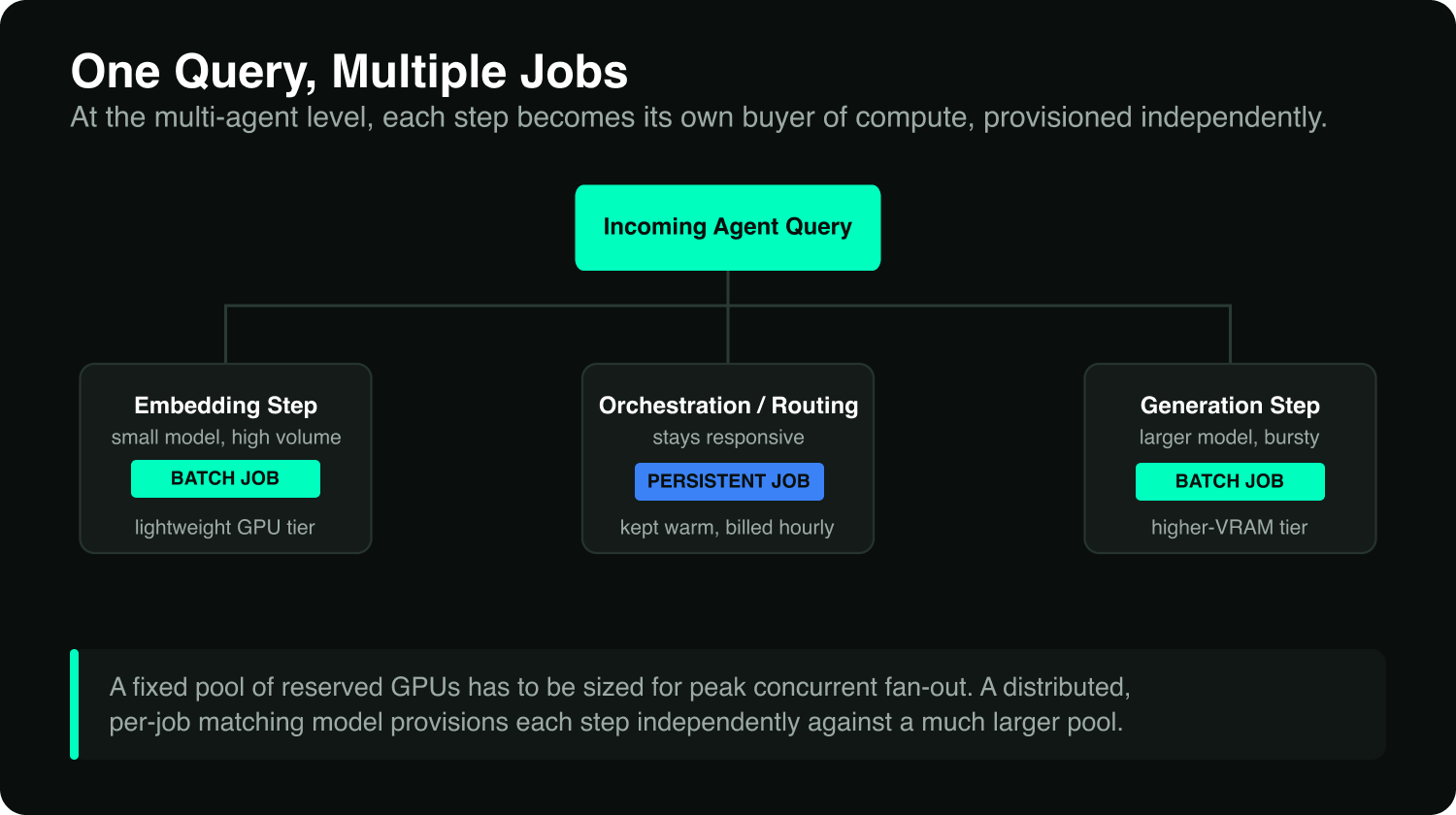
At the multi-agent level, the buyer of compute isn't a single application anymore, it's each agent or sub-task making its own request. For instance, a crypto-analysis tool running several models in parallel against cost-efficient hardware, or a multi-model assistant routing different steps to different GPU tiers. Provisioning has to happen at the granularity of the step, not the session.
This is where dedicated clusters start to strain: a fixed pool of reserved GPUs has to be sized for peak concurrent fan-out, which means overpaying for capacity that sits unused between bursts. A distributed, per-job matching model handles fan-out more naturally, because each sub-agent's request is provisioned independently against a large pool rather than queued against a small reserved one. This doesn’t eliminate latency but it does shift some of the latency variable to network/routing.
Instead of asking which is better, ask these questions about your actual agent workload:
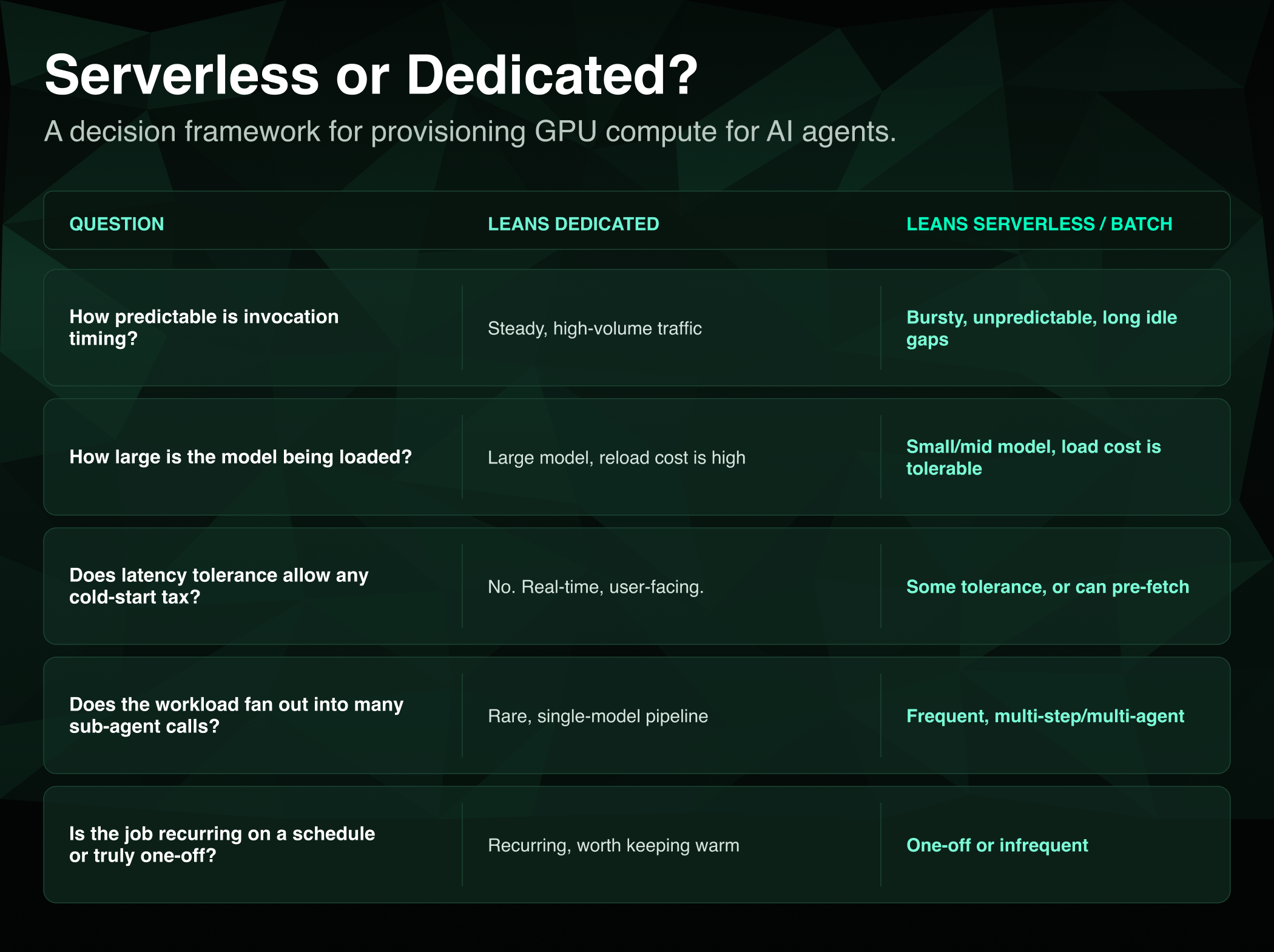
Most real agent systems land on a hybrid: a persistent job for the orchestration/routing layer that needs to stay responsive, and batch or on-demand jobs for the bursty, step-specific work fanning out underneath it. The platform question worth asking any vendor isn't "are you serverless or dedicated.” Instead, it's whether you can make that choice per job, on a distributed pool large enough that provisioning delay doesn't become its own bottleneck.


