
Hannah Barris, CEO of Ominiscient Inc, has a vision for a new category of AI infrastructure: a decentralized memory layer designed to make AI assistants persistent, personalized, and user-owned.
The premise is simple: today’s AI tools may be powerful, but they’re fundamentally stateless. Every conversation starts from scratch. Your context is fragmented across platforms. And while users generate enormous amounts of personal data, the intelligence built from that data is typically owned — and controlled — by someone else.
Omniscient wants to change that.
Built on decentralized infrastructure layers including Dispersed and Manifest Network, the platform is designed to give users greater control over how their AI systems operate, where workloads run, and how personal context is stored and processed over time.
Current AI products are optimized for inference and interaction, but not continuity. For Barris, the issue is structural.
Users can’t fully see what AI systems know about them, where that information lives, or who else has access to it. Conversations reset. Context disappears. Personal history is scattered across inboxes, notes, documents, voice recordings, and apps that rarely connect into a cohesive system.
The result is a paradox: AI models are becoming increasingly capable, yet they still lack meaningful understanding of the individual user.
According to Omniscient, the next major competitive advantage in AI won’t simply come from smarter models. It will come from context.
“Whoever owns context wins,” is how Barris framed it in her presentation at RenderCon 2026, arguing that model quality across major providers is rapidly converging. What differentiates useful AI systems is increasingly their ability to understand the user behind the prompt.
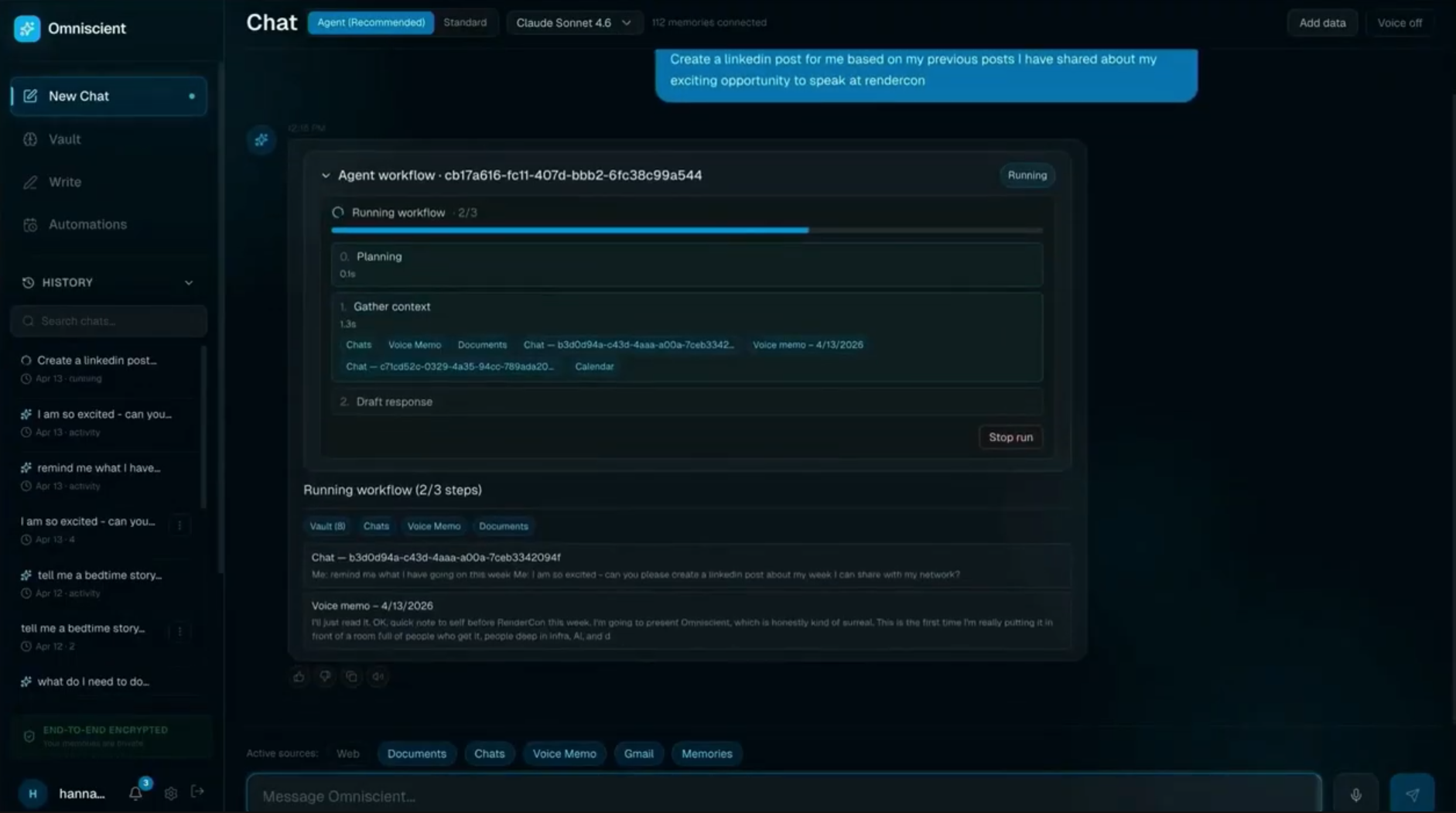
Omniscient is building what it describes as the infrastructure layer that makes every AI assistant smarter, more accurate, and more you. Rather than replacing existing AI tools, the platform is designed to sit between users and the models they already use. The idea is to structure and enrich personal data into a continuously evolving context engine.
The system aggregates user-owned information sources including emails, notes, voice data, and documents, then organizes that information into persistent memory that can ground AI outputs in real user context. The company positions this as a new category distinct from both traditional large language models and existing memory or note-taking tools.
This type of persistent contextual infrastructure requires scalable compute orchestration that can operate flexibly across environments. This is an area where Dispersed’s decentralized compute layer plays an important role. By enabling portable, containerized AI workloads, Dispersed helps support infrastructure architectures that prioritize resilience, portability, and user sovereignty rather than centralized dependency.
The company positions this as a new category distinct from both traditional large language models and existing memory or note-taking tools.
LLMs provide intelligence, but limited memory and little continuity. Memory products store information, but lack execution layers and structured contextual understanding. Omniscient aims to combine context, control, and execution into a portable system users actually own.
The broader goal is long-term continuity: an AI system that remembers, adapts, and evolves alongside the user over time instead of treating every interaction as an isolated event.
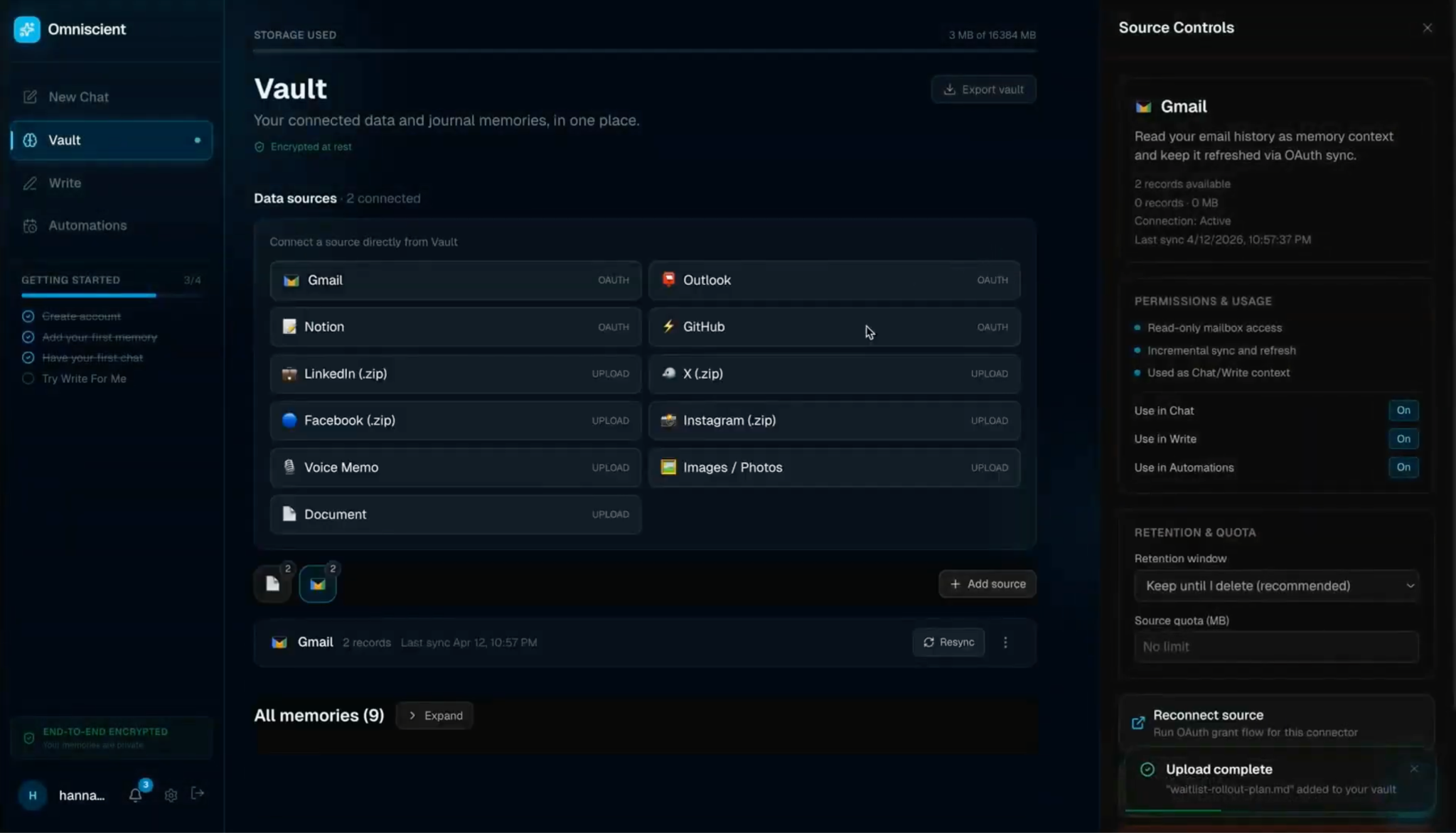
A major part of Omniscient’s architecture is its infrastructure design. The platform runs on composable decentralized infrastructure layers including Manifest Network and Dispersed, enabling portable, containerized workloads that can move across providers without vendor lock-in.
Dispersed’s distributed compute infrastructure allows AI applications like Omniscient to deploy workloads dynamically across decentralized resources while maintaining operational flexibility as usage demands evolve. That flexibility becomes increasingly important for applications managing persistent context, retrieval systems, and continuously updating memory architectures.
According to Barris, that infrastructure choice is foundational to the company’s philosophy around sovereignty and ownership. User-owned AI requires more than application-layer privacy controls. It also requires infrastructure capable of preserving portability, governance flexibility, and data control over time.
Omniscient’s container-first architecture allows workloads to deploy consistently across environments while maintaining operational flexibility as infrastructure requirements evolve.
That approach enables:
Rather than forcing users into closed ecosystems, the architecture is designed to preserve optionality.
Built on composable infrastructure (e.g., Manifest Network and Dispersed), it leverages decentralized compute networks to enable portable, containerized workloads across providers, ensuring data sovereignty, privacy, and resilience without vendor lock-in.
As model capabilities converge, Omniscient positions context ownership as the key competitive advantage. The goal is to allow users to retain control of their data while powering more accurate, context-aware AI experiences across any model or platform.
Omniscient ultimately frames itself not as another AI assistant, but as a sovereignty layer for AI systems. The company’s thesis is that personal intelligence infrastructure should belong to the individual user — not remain fragmented across platforms or trapped inside proprietary ecosystems. As Barris concluded during the presentation:
“Your data. Your context. Your AI.”
For Omniscient, the future of AI isn’t just about generating outputs. It’s about building systems that can continuously understand the people using them — while allowing those users to retain ownership and control over the intelligence built from their own lives.
Omniscient ultimately frames itself not as another AI assistant, but as a sovereignty layer for AI systems.
The company’s thesis is that personal intelligence infrastructure should belong to the individual user, not remain fragmented across platforms or trapped inside proprietary ecosystems.
As Barris concluded during the presentation:
“Your data. Your context. Your AI.”
For Omniscient, the future of AI isn’t just about generating outputs. It’s about building systems that can continuously understand the people using them while allowing those users to retain ownership and control over the intelligence built from their own livesvision for a new category of AI infrastructure: a decentralized memory layer designed to make AI assistants persistent, personalized, and user-owned.


