
OrbitRisk is a satellite risk intelligence platform that combines live environmental inputs, orbital mechanics modeling, collision probability analysis, and cybersecurity signals to generate dynamic risk profiles for satellite operators and insurers.
As Earth’s orbital environment becomes more crowded, volatile, and strategically important, satellite operators and insurers face a growing challenge: too much critical data moving too fast to interpret manually.
Collision probabilities shift by the hour. Space weather events can disrupt systems unexpectedly. Encryption vulnerabilities evolve constantly. Orbital behaviors create cascading downstream effects that are difficult to model in isolation.
OrbitRisk is designed to make sense of that complexity.
Built as a predictive satellite risk intelligence platform, and powered by Dispersed, OrbitRisk transforms orbital, environmental, and cybersecurity data into live, decision-ready intelligence for satellite operators, insurers, and risk analysts. Instead of forcing teams to manually correlate fragmented datasets, the platform surfaces hidden patterns, emerging threats, and future exposure scenarios through dynamic visualization and predictive modeling.
The result is a system built not just to monitor satellites but to understand risk behavior across an entire orbital ecosystem.
Avia Kraft is CEO of CorpusPark, a lab incubating decentralized projects. One of them is OrbitRisk, a platform designed to combine live operational inputs with orbital mechanics modeling to generate continuously evolving satellite risk profiles.
The platform ingests variables including:
These inputs are continuously analyzed to generate predictive risk scoring and future exposure projections.
Rather than treating risk as a static snapshot, OrbitRisk models how risk evolves over time.
Preconfigured risk profiles include forward-looking projections tied directly to orbital mechanics modeling, allowing operators to visualize potential exposure not only in the present moment, but months or even years ahead.
This enables users to anticipate downstream operational and financial consequences before they escalate into major incidents.
One of the platform’s most powerful capabilities is its ability to reveal patterns that would be nearly impossible to identify manually.
OrbitRisk can visualize satellite clusters, vulnerability concentrations, and anomalous behaviors across projection maps and dynamic global views. As users adjust risk profiles, the platform recalculates exposure categories in real time, instantly changing how orbital relationships and vulnerabilities are interpreted.
According to the demo, these visualizations frequently surface:
These are the kinds of signals that traditional spreadsheets and isolated dashboards often fail to expose.
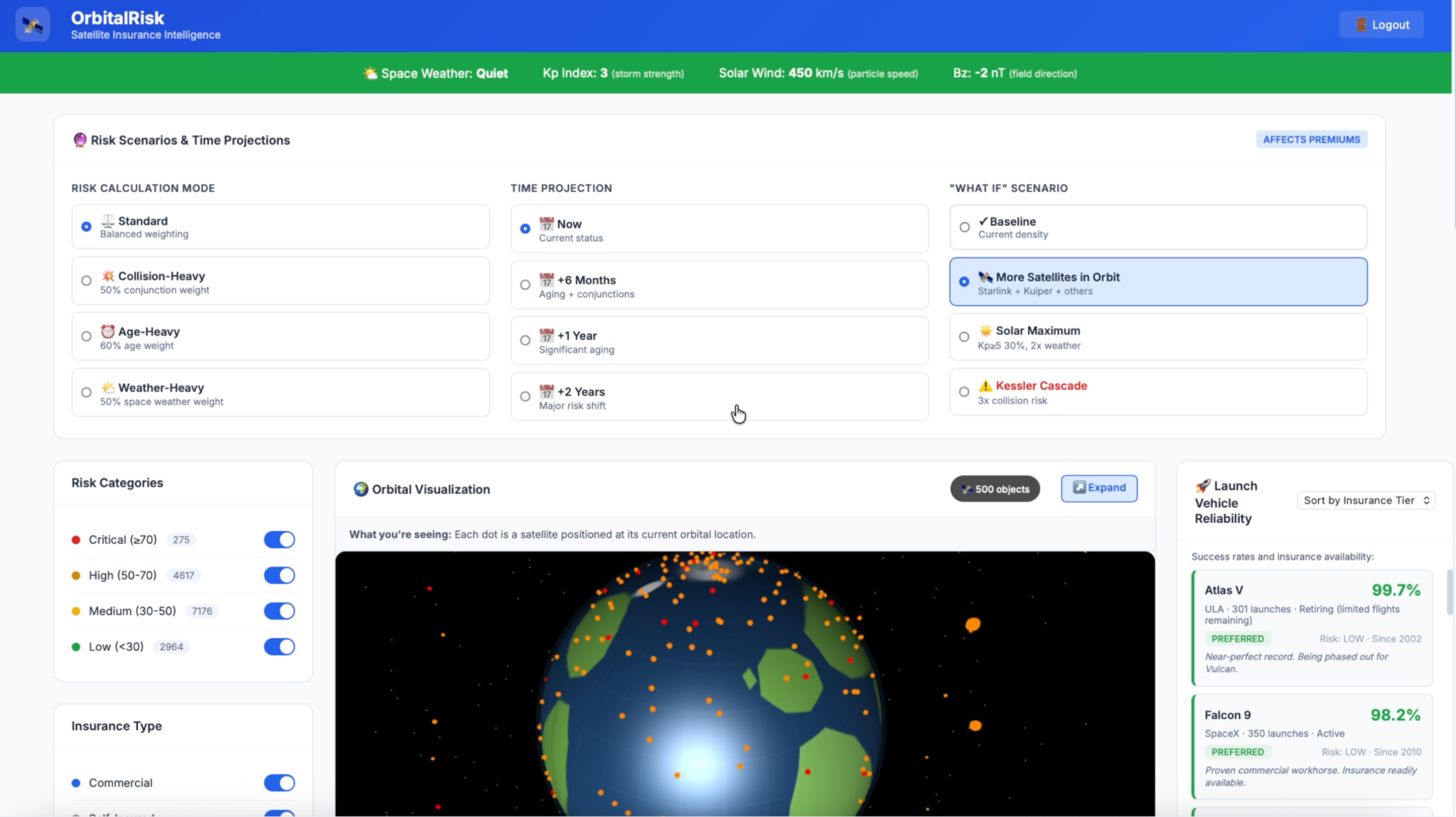
The platform’s projection mapping system helps operators understand how a satellite’s relative risk profile could influence orbital behavior both now and in future trajectories. That creates a more intuitive understanding of systemic exposure, particularly valuable for insurers and large fleet operators making underwriting or operational decisions.
Satellite insurance has historically relied on relatively static assessments, limited historical datasets, and fragmented operational visibility. OrbitRisk introduces a more dynamic approach.
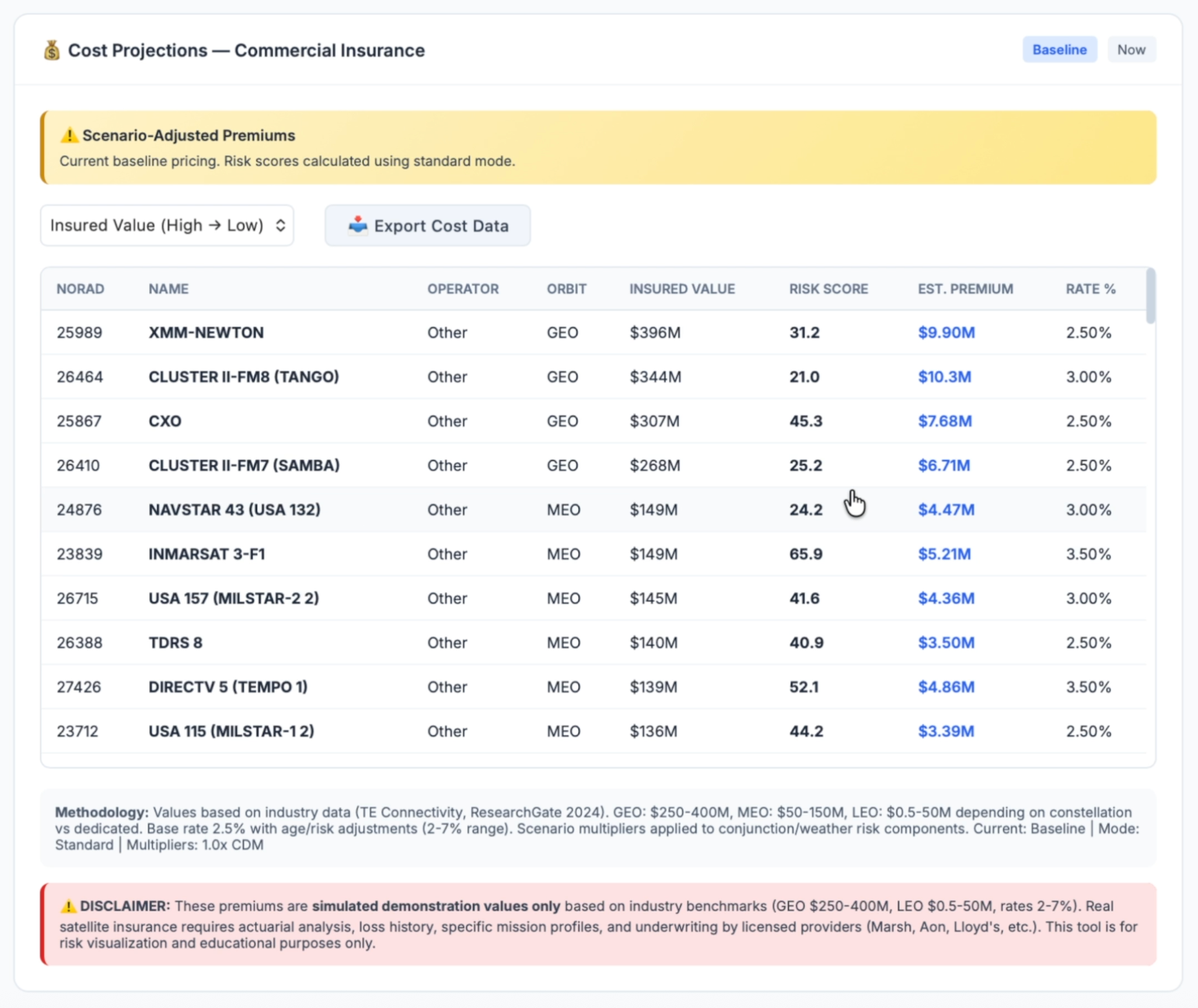
Users can upload their own operational datasets and configure variables such as expenses, acceptable loss ratios, and custom risk thresholds. The platform then transforms raw fleet data into continuously updated intelligence models and topline reporting outputs.
This creates a more adaptive framework for evaluating exposure in an increasingly volatile orbital environment.
The broader shift mirrors trends emerging across the space intelligence sector, where companies are increasingly using real-time orbital analytics and AI-driven monitoring systems to improve space domain awareness and operational forecasting.
A particularly unique element of the platform is its integration of the open-source MemPalace memory layer associated with Milla Jovovich.
According to the presentation, this memory architecture helps OrbitRisk surface emergent insights between highly complex variables in a more intuitive way.
Rather than treating each signal independently, the memory layer enables relationships between datasets to persist and evolve over time. This allows the system to identify contextual patterns that might otherwise remain hidden across rapidly changing orbital and cybersecurity conditions.
The approach aligns with broader experimentation happening across AI memory systems, where persistent contextual architectures are being explored as a way to improve long-term reasoning and multi-variable analysis.
The roadmap presented during the demo points toward an increasingly open and extensible intelligence system.
Future iterations of OrbitRisk are expected to allow users to upload virtually any relevant operational or environmental dataset directly into the platform, including:
That flexibility could significantly expand how organizations model interconnected orbital risk across technical, financial, and geopolitical dimensions.
As satellite constellations continue to scale globally, the ability to fuse live operational data with predictive intelligence may become essential infrastructure for the broader space economy.
Because in orbit, the most dangerous risks are often the ones no one sees coming.


