
Anyone searching for a bare-metal GPU rental alternative for compute-heavy work like inference tasks already knows what bare metal gives them: a physical machine, full root access, nothing virtualized between them and the hardware. The real question isn't whether Dispersed is bare metal. It isn't. The real question is narrower and more useful if you’re looking for affordable, flexible compute: for the workload you actually have, does that difference matter, and is there anything bare metal doesn't solve that a distributed network does?
Compute jobs on Dispersed run inside dedicated, isolated Docker containers, with the GPU passed through directly via the NVIDIA Container Toolkit. There's no hypervisor in that path. There’s no layer translating instructions, splitting memory bandwidth across guest VMs, or introducing the scheduling jitter that shows up on a fully virtualized cloud instance. That overhead is where most of the performance gap between "bare metal" and "cloud instance" actually lives, and it's a gap largely closed by containers.
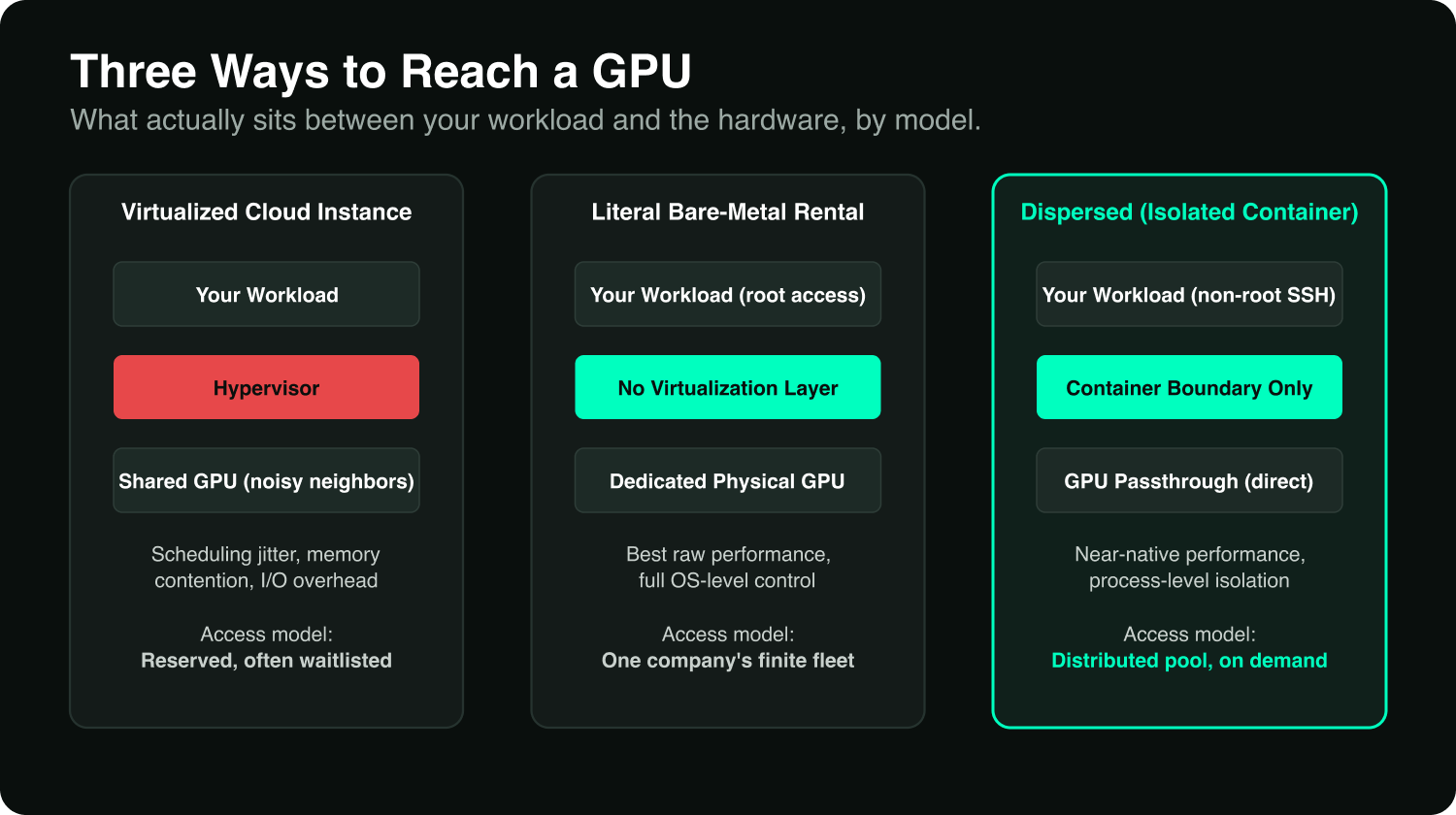
What containers don't give you is root access to the physical box. You connect via SSH into the running container, as a non-root user with narrowly scoped permissions, not into the host machine itself. It’s not that it’s "as good as bare metal.” It's closer to: for a workload that's GPU-bound rather than OS-bound, the performance difference between a container with GPU passthrough and a bare-metal lease is small enough not to be the deciding factor. If your workload needs to touch the kernel directly, then actual bare metal makes sense. That encompasses needs such as custom drivers, kernel modules, or hardware outside what the container runtime exposes.
Renting bare metal doesn't solve the GPU compute availability problem, because a bare-metal provider still has one company's physical fleet. H100 and H200-class machines are exactly the tier where that shows up. Namely, the issue is a specific rack of specific machines, in specific data centers, that someone else is also trying to rent right now. That's why "bare metal H100 rental alternatives" is a phrase people search in the first place. The problem was never that bare metal is virtualized. It's that bare metal is still one fleet.
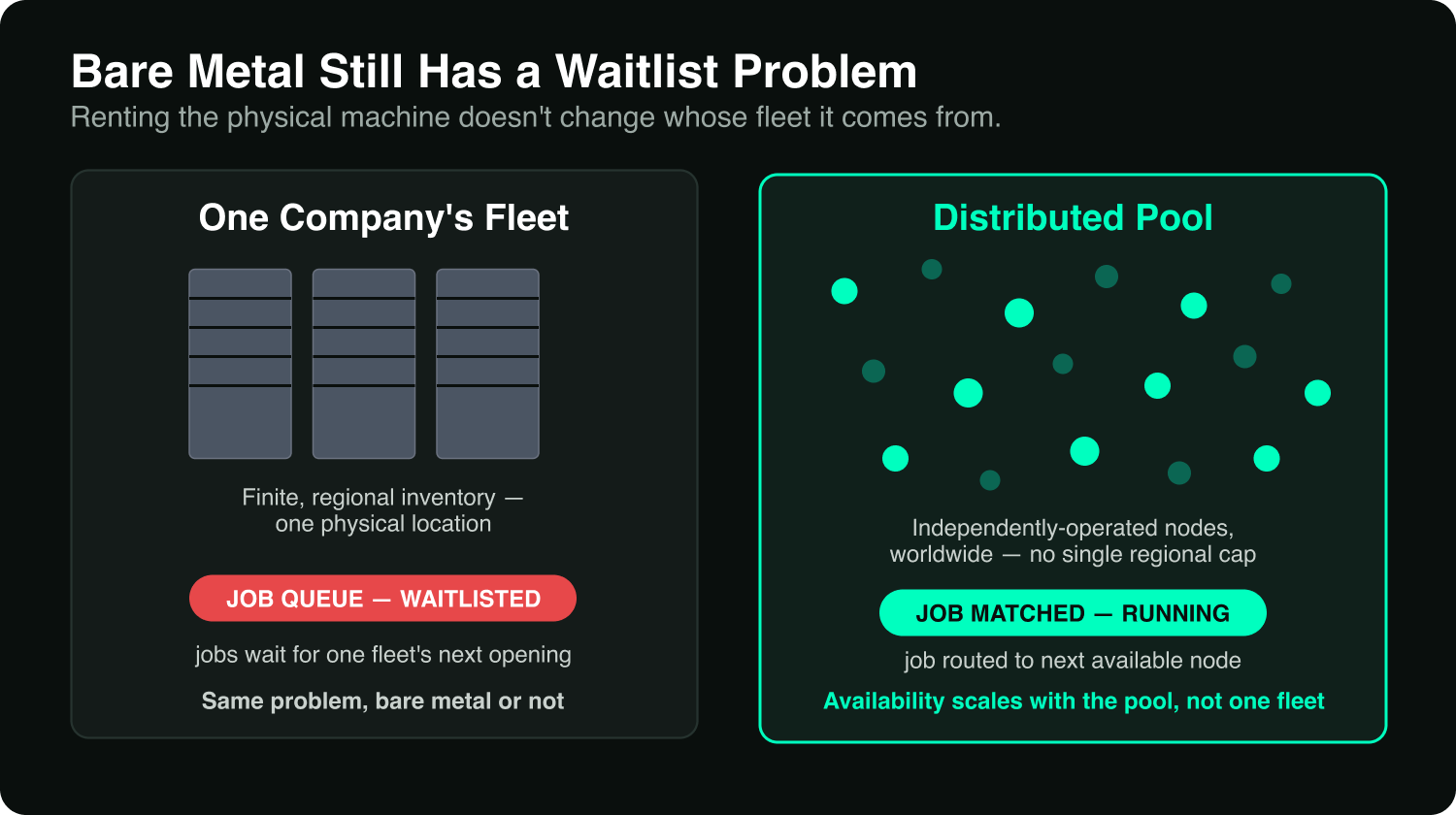
Dispersed's model is structurally different on this specific point, not just cheaper or friendlier. Jobs get matched against a distributed pool of GPUs supplied by independent GPU operators around the world, rather than reserved from a single company's regional inventory. A job moves from `PENDING` to `ASSIGNED` to `RUNNING` as the network searches that pool for a match. If it sits in `PENDING`, that's a sign the requested spec is narrower than what's currently available across the pool, not a sign you're waiting behind other customers for a specific SKU from one provider's rack. This is the same pattern already running in production: 3D Gaussian splatting jobs get routed to whichever verified RTX 4090 or 5090-class GPU is available across the pool the moment they're submitted, and a recurring job like Bitmap's daily sculpture render gets matched, run, and torn down the same way every single day, with no reservation sitting in between.
Provisioning a literal physical machine has real overhead: You have to imagine the box, hand it off, and then tear it back down when you're done. That overhead is part of why bare-metal rental tends toward hourly minimums or short-term contracts even when there's no formal long-term commitment attached. It isn't really a policy choice; it's a consequence of what it takes to hand someone a whole machine.
A container spinning up on a GPU that's already online and already configured doesn't carry that same overhead, which is what actually makes sub-hourly billing possible rather than just cheaper-sounding. Every job on Dispersed is one of two types: a batch job, which bills only for the time it actually runs and shuts down automatically at completion or timeout, or a persistent job, which bills hourly and runs until you stop it. The batch option specifically doesn't have an equivalent in a model where standing up the hardware itself takes real physical setup time. It's a byproduct of the container model, not a discount layered on top of the bare-metal one.
Actual bare metal comes with bare-metal responsibilities: you're the one choosing the OS image, installing drivers, and keeping both patched. On Dispersed, that layer is handled by the operator running the GPU software. You, as the end user, submit a Docker image specifying your hardware requirements, and the network handles matching it to a properly configured machine. That's a smaller scope of responsibility, and it matters most for teams who want GPU access without also taking on infrastructure maintenance as a side effect of getting it.
None of this makes Dispersed a strict upgrade over bare metal, and the cases where bare metal is still the right call are specific. For instance, if a workload needs kernel-level access, custom drivers, direct hardware control outside what a container runtime exposes, or GPU-to-GPU interconnects (like NVLink across multiple physical machines) that depend on a specific physical topology, that's a real reason to rent the actual machine rather than a container running on one. The same is true for compliance frameworks that specifically require physical machine isolation as an audit requirement, not just process-level isolation.
For everything else, such as most GPU-bound training, inference, and other general compute work, the deciding factor usually isn't root access. It's whether the hardware is actually available when you need it, and that's the question a distributed pool answers differently than any single bare-metal provider's fleet can.


