
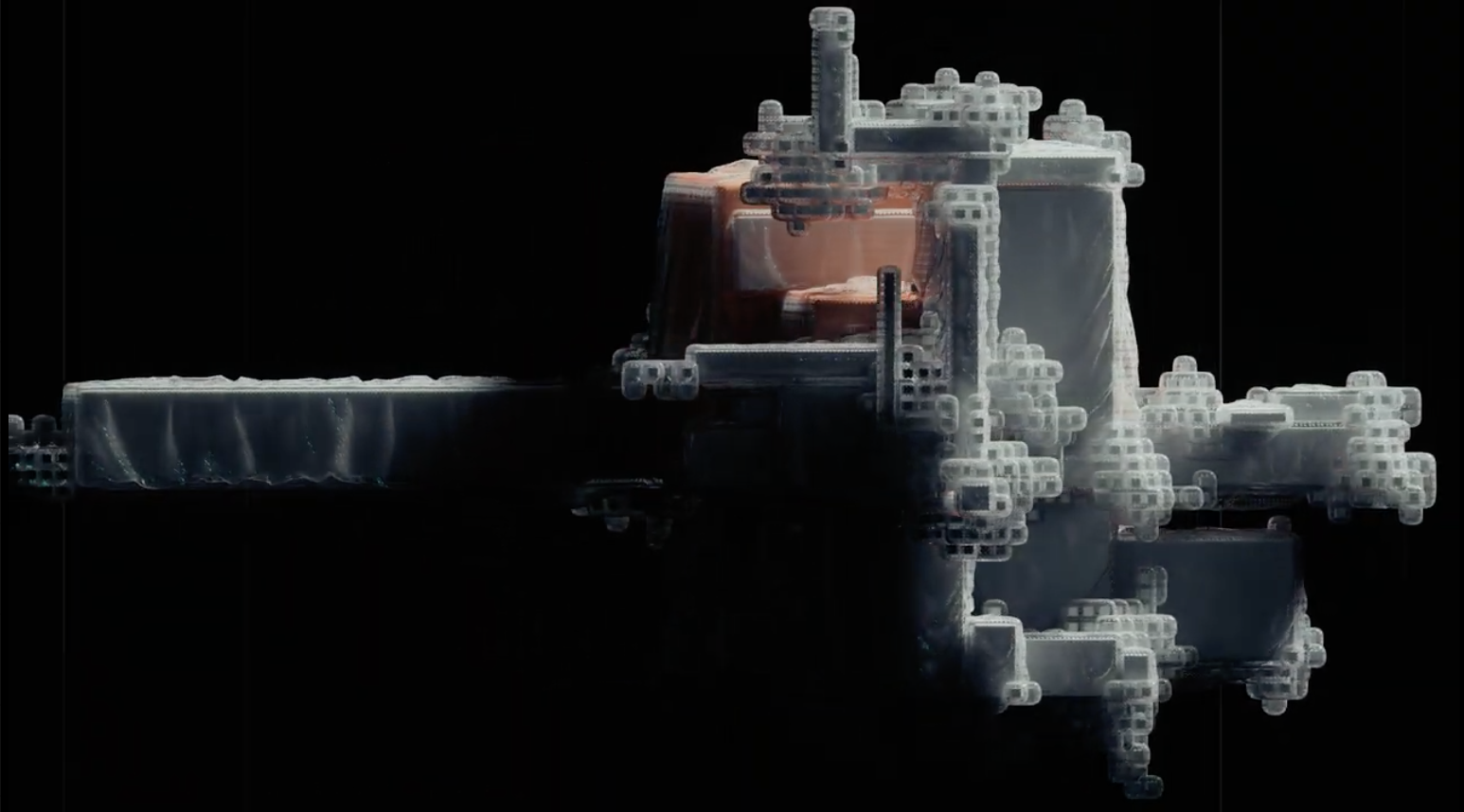
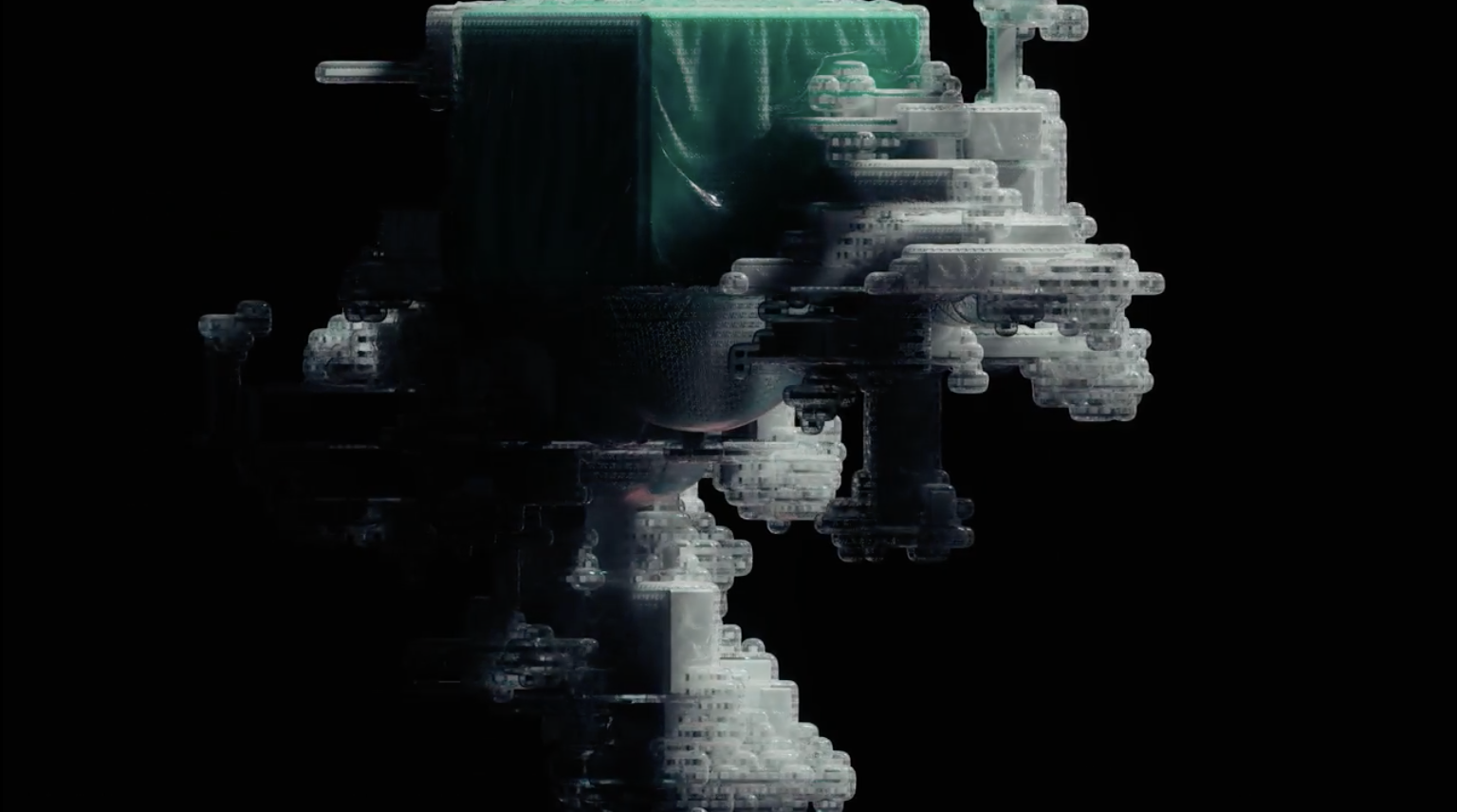
Muhammet Altun, the 3D artist known as MHX, built a system called Bitmap that takes one Bitcoin block a day and grows its transaction data into a unique, animated 3D sculpture. A block is capped at roughly 4 MB. That’s about the size of a high-quality JPEG. But it's a dense seed. A single block averages around 3,000 transactions, and Altun's algorithm expands that metadata into a sculpture built from thousands of individual cuboids. A tiny input, a massive processing job.
That expansion ran into a wall almost immediately. On a high-end local workstation, turning one block into a 4K sculpture took about 35 hours, well past the 24-hour window the daily series demanded. Running it locally meant a personal computer would need to become an always-on server and a single point of failure. Moving it to a traditional cloud like AWS would have solved the reliability problem but added the DevOps overhead and cost that makes cloud GPU access painful for a solo artist running a daily generative project.
Altun split the work across two layers of the Render ecosystem. Dispersed handled the computation: running his Houdini pipeline, orchestrated by Houdini's Procedural Dependency Graph, to construct the geometry. The Render Network API handled the parallel frame rendering. He packaged Houdini and OctaneRender into a single Docker image and found 1:1 parity between his local environment and the Dispersed nodes, which made testing and deployment straightforward instead of a slog. A lightweight Cloudflare Worker now triggers the pipeline every day, submitting a signed job request to the Dispersed API for a node with 16 CPU cores in one GPU, 32 GB of RAM, and 16 GB of VRAM.
The result: generation time dropped from 35 hours to 15 minutes. Altun estimates the compute cost at a few cents per sculpture on Dispersed, compared to roughly $8 per piece on traditional clouds, a reduction of more than 95%. Bitmap launched on Jan. 1, 2026, and has run autonomously every day since, producing one sculpture without any manual intervention.
On the surface, it seems like a small story. One artist, one daily art project, one Docker image. But it's worth sitting with, because it's not really a story about AI. It's a story about rendering, the same kind of problem that distributed GPU networks have been solving since long before anyone was fine-tuning a language model.
A decentralized GPU architecture is perfect for AI jobs for the same reason it’s perfect for 3D rendering: generative AI's compute profile is bursty and parallel. In fact, the parallelizable jobs spike hard and then disappear. That’s nearly identical to the compute profile of 3D rendering. Rendering studios have lived inside that exact demand curve for two decades. A render job for a film sequence or a game cinematic doesn't need a GPU cluster sitting idle 350 days a year waiting for the other 15. It needs a massive amount of parallel compute for a short, unpredictable burst, and then it needs to release that compute the second the job is done.
Dispersed didn't pivot into AI because AI is trendy. It exists because AI compute caught up to a problem the team behind it had already spent years solving for motion graphics and VFX. That team is the team who built Render Network, starting back in 2017.
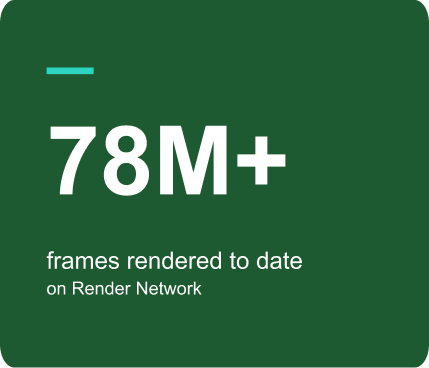
The Render Network's numbers make the case on their own. More than 78 million image frames have been rendered on the network as of August of 2026. It has handled projects for NASA's Benefits for Humanity initiative, powered the Las Vegas Sphere's Coca-Cola campaign, rendered stadium-scale visuals for the Super Bowl LIX countdown trailer, been used for stage visuals for Coachella and UNVRS, generated background visual experiences for Latin Grammys performances, enabled the Sunspark animated film accepted into 30+ film festivals, and rendered thousands of GPU-hours of 4K game animation for the Pudgy Penguins franchise. Studios like Athens-based Yeti Pictures use it for Octane-powered rendering on award-winning title sequences. That's not a hypothetical use case list. It’s a decade of production workloads run at scale, on a network built to aggregate idle, distributed GPUs rather than lease captive ones.
Dispersed, launched in December 2025 as the AI-focused subnet of that same ecosystem, inherits the plumbing that made all of that possible.
It's worth being specific about what transfers from rendering infrastructure to AI infrastructure, because the overlap is deeper than "GPUs are GPUs."
A rendering network never gets to assume every node looks the same. Some operators run a single gaming GPU, others run racks of accelerators. The Render Network solved this years ago with OctaneBench, a performance benchmark that scores every node and assigns work accordingly. Dispersed uses the same logic under a different name: node rewards scale with a specification-based multiplier, benchmarked so that an RTX 4090 sits at a baseline of 1.0. A job asking for a specific hardware profile gets matched to a node that can actually deliver it. That capability only matters once your supply is genuinely heterogeneous, which centralized clouds, by design, rarely have to deal with.
Long before "containerize your model" was standard AI infrastructure advice, rendering pipelines were packaging scene files, textures, and render engines into portable containers so a job would behave identically whether it ran on an artist's workstation or a stranger's GPU on the other side of the world. Altun's report of 1:1 parity between his local Houdini environment and Dispersed's nodes isn't a lucky accident but rather the direct result of a network built around the assumption that you cannot trust any single node's environment, so you standardize the package instead. Dispersed's use of standard Docker containers for AI workloads is the same design principle, just pointed at PyTorch and ComfyUI instead of Cinema 4D and Redshift.
A render job doesn't reserve a GPU for a month. It grabs one, runs, and lets go. Dispersed's stateless job model—match, assign, execute, auto-teardown—is the rendering industry's cost model applied to inference and training. Bitmap's numbers illustrate why that matters at the extreme end: a $8-per-sculpture cloud bill became a few cents once the workload stopped paying for standing infrastructure it only needed for 15 minutes a day.
Creative studios have never budgeted compute the way ML teams are now being asked to. A studio doesn't reserve a cluster for the quarter; it prices a job, runs it, and pays for what it used. That's a fundamentally different mental model from the reserved-instance, always-on thinking that hyperscalers built their AI compute pricing around. It's exactly the model long-tail generative AI workloads (batch image generation, synthetic data creation, one-off fine-tuning runs) actually need.
This overlap is already showing up in production.
Bitmap itself sits at the seam: a generative art project that uses a traditional rendering pipeline (Houdini, OctaneRender) to visualize data in a way that's procedurally generated, not hand-authored. It's not a rendering job in the old sense, and it's not a pure AI inference job either. It's both, running on infrastructure that doesn't force a choice between the two.
The broader Render ecosystem is seeing the same convergence from other directions. At RenderCon 2026, teams like Manifest Network and Sarson Funds demonstrated AI agents that source GPU power from Dispersed the moment a workload appears, rather than reserving cloud compute permanently. Manifest showcased an encrypted multi-model AI assistant, called Agent1, which splits a single user query into three distinct GPU jobs (embedding, orchestration, and inference), running each on a different GPU tier based on what that specific step actually needs. That's a resource-allocation instinct rendering pipelines have used for years. It puts the lightweight pass on cheap hardware and saves the expensive GPU for the step that needs it. In this case, it’s applied to an AI agent's internal reasoning steps instead of a scene's compositing layers.
For creative studios and generative AI builders specifically, being sold "cloud GPU for ML" tooling built around Jupyter notebooks and reserved training clusters is an infrastructure gap that's been quietly frustrating them. These types of users need an answer for running diffusion batch jobs, requiring synthetic data generation for computer vision, or getting AI-assisted previz mixed with traditional rendering passes. It's not a new category of compute. It's the same category rendering studios have used all along, extended to cover the AI-generation layer that's increasingly part of the same pipeline. That’s what a network built with these specific workflows in mind can offer them.
None of this holds together without the idle-capacity argument underneath it. Estimates have put the amount of global GPU capacity that sits unused at any given time at 40%. This consists of gaming rigs, creative desktops, crypto-era hardware, and enterprise fleets bought ahead of need. That statistic isn't an abstraction for a network built the way Dispersed is; it's the entire supply side of the marketplace. Node operators monetize hardware that would otherwise sit dormant between jobs, and service consumers get access to that capacity at a fraction of what it costs to keep a dedicated GPU fleet running around the clock.
For bursty, spiky creative and generative AI workloads specifically, that's not just a cheaper way to buy the same thing hyperscalers sell. It's a pricing model that actually matches how the work happens. A daily art project that needs 15 minutes of GPU time doesn't want to pay for the other 23 hours and 45 minutes. Neither does a studio running an overnight batch render, or a generative video startup iterating on a model between funding rounds. The economics of idle-capacity sourcing and the economics of creative, on-demand compute demand aren't a coincidence.
Dispersed's team didn't build a new kind of network to chase the AI boom. They took a network that had already rendered tens of million frames, powered the Las Vegas Sphere, and rendered game animation in 4K for Pudgy Penguins, and pointed its existing architecture at a compute problem that turned out to look a lot like the one they'd already solved. That architecture consists of heterogeneous job matching, container-native portability, ephemeral execution, and idle-capacity sourcing.
Bitmap is a small, specific proof of that. One artist, one daily sculpture, a 35-hour job turned into 15 minutes, an $8 cost turned into a few cents. It's not a benchmark chart or a whitepaper claim. It's a working pipeline that runs itself, every day, without anyone checking in on it. That, in the end, is the whole promise of infrastructure that finally fits the shape of the work.


