
"Web3 compute" is what people think of when they see decentralized compute, usually right next to a promise of being cheaper than AWS. That's not wrong, exactly, but it skips the part that actually matters: cheaper compute isn't the result of some crypto magic. It's the downstream effect of a genuinely different architecture, where ownership and coordination work differently than they do in the cloud model most developers have come to know.
It's worth being precise about what's actually different, because the honest answer is "quite a lot in some places, and almost nothing in others."
Start with the most basic structural question: who owns the GPU you're renting?
In the traditional cloud model, exemplified by AWS, Google Cloud, Azure, and the specialized GPU clouds that have emerged alongside them, the answer is simple. The provider owns the data centers, owns the racks, owns the hardware lifecycle, and sells you time on it. Every part of that stack, from procurement to power to physical security, sits inside one company's balance sheet. That's a real strength: it's why hyperscalers can offer long-term SLAs, deep enterprise support contracts, and guaranteed access to frontier-class hardware like reserved H100 or H200 pools.
In a decentralized compute network like Dispersed or Render Network, the answer is different by design. Compute capacity suppliers can be anyone from an individual with a single gaming GPU to an enterprise running racks of accelerators. They register their own hardware and earn for making it available. The network itself doesn't own a single GPU. It's a marketplace: a matching system that connects Service Consumers who need compute to Node Operators who have idle capacity, handles the container isolation and job execution, and settles payment, in Dispersed's case through the RENDER onchain economy.
That's the real definition of web3 compute: a coordination layer that lets independently owned hardware function as a single accessible marketplace, without any single company owning the underlying fleet, where resource suppliers receive earnings for it.
This ownership difference changes the entire cost structure underneath the product.
Hyperscaler pricing is built around scarcity and reservation. You commit to an instance, often for a fixed term, and you pay for that reservation whether or not you're using it every hour of every day. That model works well when demand is predictable and utilization is high. It works poorly when a workload is bursty, which describes an enormous amount of AI and rendering work: a batch inference run, a nightly render job, a single fine-tuning pass. In fact, an increasingly large percentage of AI workloads is estimated to be inference. McKinsey puts it at 40% by 2030. Others put it at 80% in the next 12-24 months.
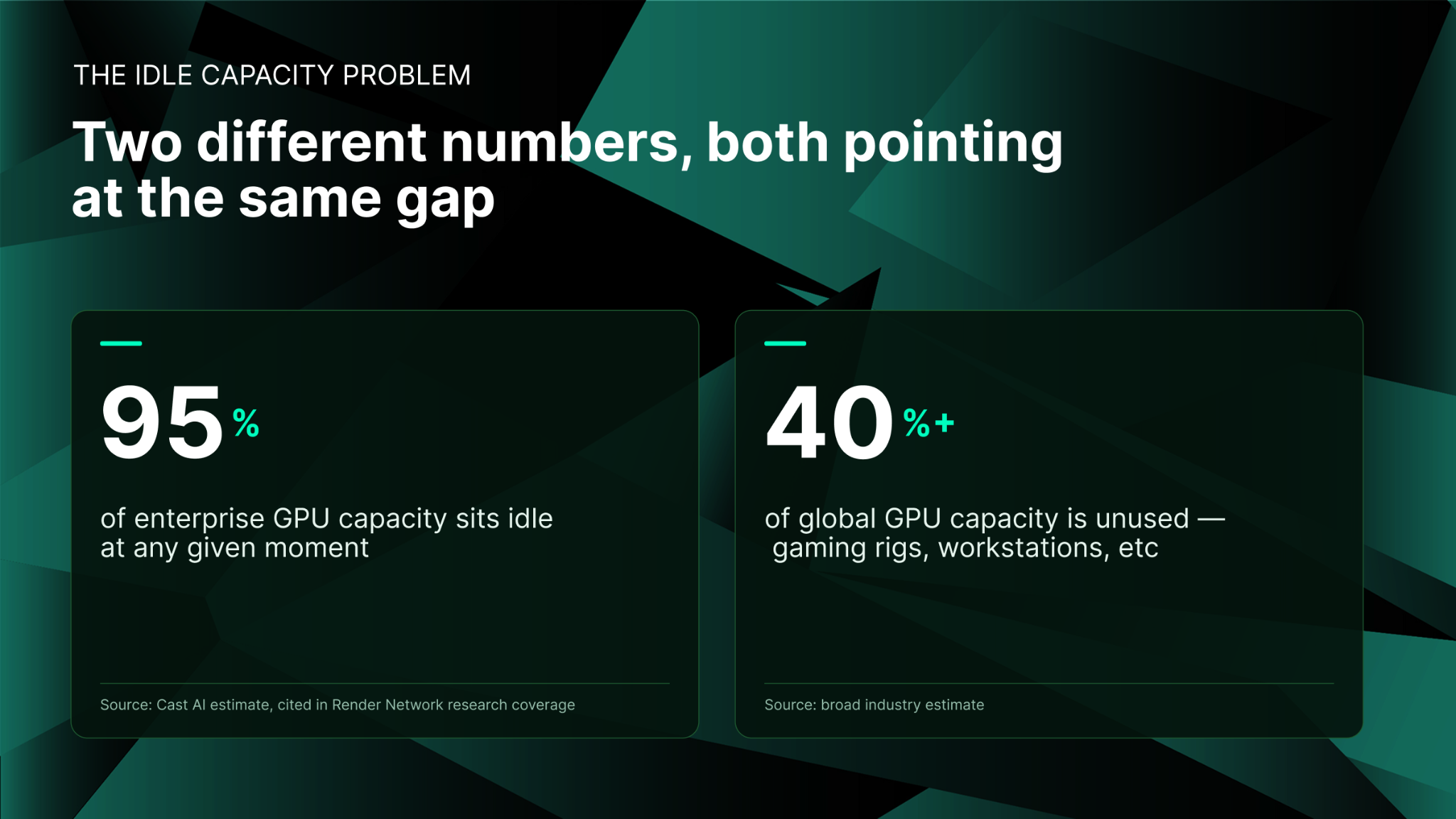
When it comes to actual GPU utilization, recent estimates put average enterprise GPU utilization at close to 5%, meaning 95% of enterprise GPU capacity sits idle at any given moment, according to Cast AI. Separately, broader estimates suggest more than 40% of global GPU capacity goes unused at any point in time. These GPUs include gaming rigs, creative workstations, and enterprise fleets bought ahead of need. Those aren't the same number measuring the same thing, but they point at the same underlying dislocation: a lot of GPU silicon exists, and a lot of it isn't doing anything most of the time.
A decentralized marketplace is built specifically to close that gap. Node operators get rewarded for putting their hardware to use that would otherwise sit dormant. Compute consumers get access to that capacity priced by actual execution time rather than a fixed reservation window. Dispersed, the AI compute network by the people behind Render Network, prices jobs down to the millisecond for persistent workloads and by actual run time for batch jobs. This kind of pricing granularity only makes sense once you've decoupled "the hardware I'm renting" from "the company that owns a data center."
There's a less obvious structural difference worth naming, because it's specific to how decentralized networks like this are actually run: who decides what changes.
A hyperscaler's roadmap, pricing changes, and infrastructure decisions are made internally, by that company, for reasons it doesn't have to disclose. A network like Dispersed operates under a public governance process instead. Render Network Proposals (RNP-019 and RNP-021) go through a structured, multi-stage process. They involve an initial proposal, community draft feedback, a foundation feasibility review, an initial sentiment vote, and then a final vote requiring both a majority of votes cast and a quorum of at least 15% of the total token supply participating. The foundation overseeing the process doesn't hold veto power.
It means decisions like "should this network add support for a new AI workload type" or "how should node operator rewards be adjusted" go through a visible, contestable process rather than a closed-door product meeting. It’s a real, structural difference, not a marketing distinction.
None of this makes decentralized compute a strictly better answer, and it's worth being honest about where the tradeoffs cut the other way.
Centralized cloud still has real advantages: deep enterprise support relationships, long operating track records, guaranteed access to the newest frontier-class hardware before it reaches broader distribution, and infrastructure teams who will get on a call with you when something breaks. Decentralized networks, including Dispersed, are candid about their own risks. They include supply-side fragility (if node operators don't supply enough GPU capacity to meet demand, service consumers can leave for more reliable, even if costlier, alternatives); broader market risk tied to the sustainability of current AI investment levels; and execution risk in competing against both centralized clouds and other decentralized networks for the same demand.
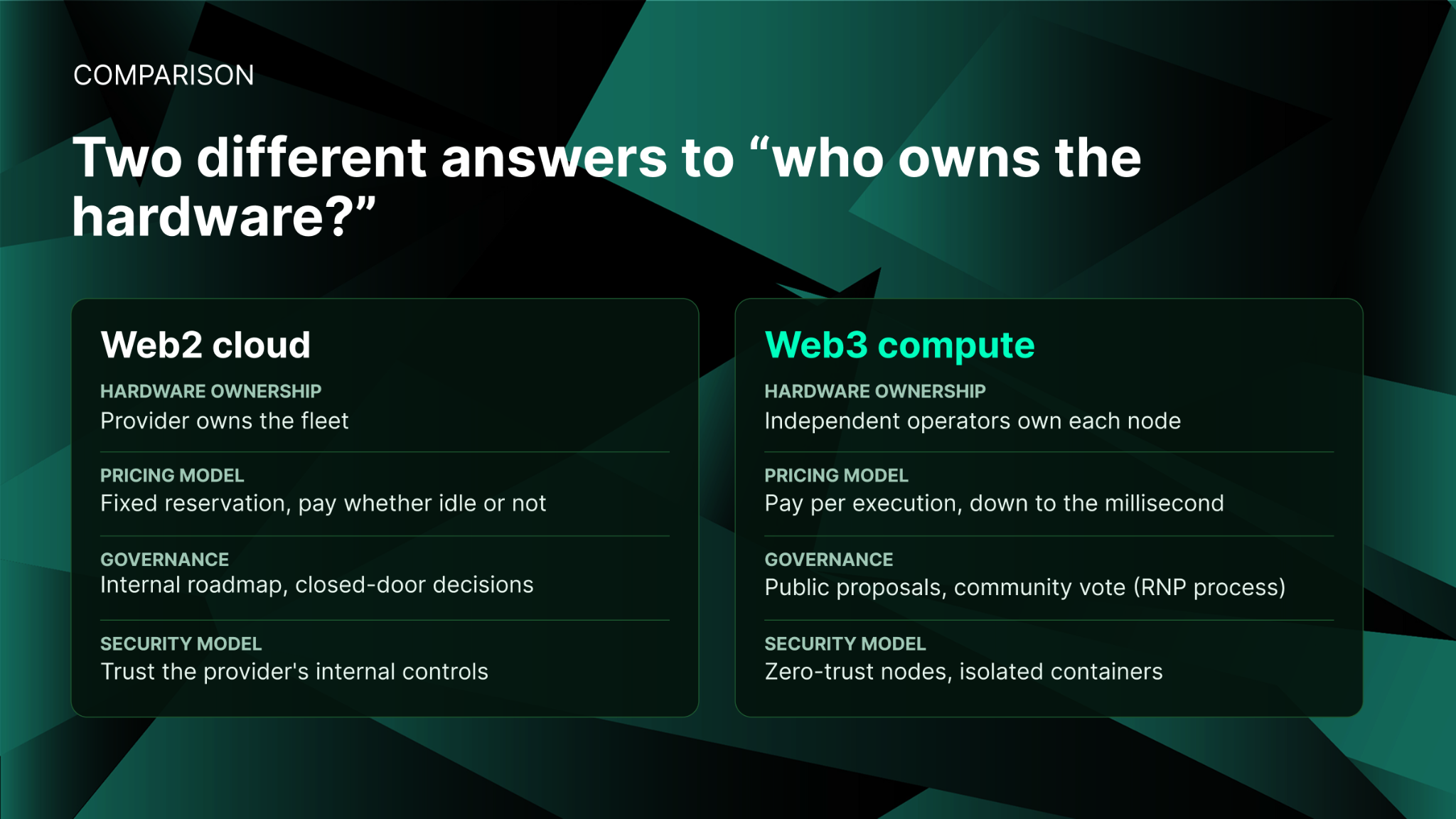
Decentralized compute, in turn, offers things centralized cloud structurally can't: no vendor lock-in, container-native portability instead of proprietary APIs, as well as pricing that matches idle-capacity economics rather than reservation economics. Importantly, for networks like Dispersed specifically, a key difference is the different security model built around zero-trust node isolation rather than trusting a single provider's internal access controls.
The honest framework isn't "web3 compute vs. web2 cloud" as a binary choice.Rather, it's about matching the model to the workload.
Bursty, parallel, finite-duration jobs like batch inference, rendering, generative AI pipelines, synthetic data generation, agent workloads that spin up and down unpredictably, fit the decentralized, pay-per-execution model well. The pricing structure is built for exactly that shape of demand. Workloads that need a guaranteed, uninterrupted multi-week reservation on a specific frontier-class GPU, backed by an enterprise support contract, still lean toward hyperscalers or specialized GPU clouds built around reserved capacity.
Most serious infrastructure decisions in the coming years aren't going to be "pick one." They're going to be workload-by-workload: Reserved capacity for the steady-state production system, decentralized on-demand capacity for the bursty experimentation, batch processing, and agentic workloads that don't need a standing server at all. The two models aren't really competing for the same job. They're built for different shapes of demand, and the more clearly a team understands which shape its own workload actually is, the easier that decision gets.


